AI for Environmental Engineering
First 2027 scholarship call
AI for Environmental Engineering
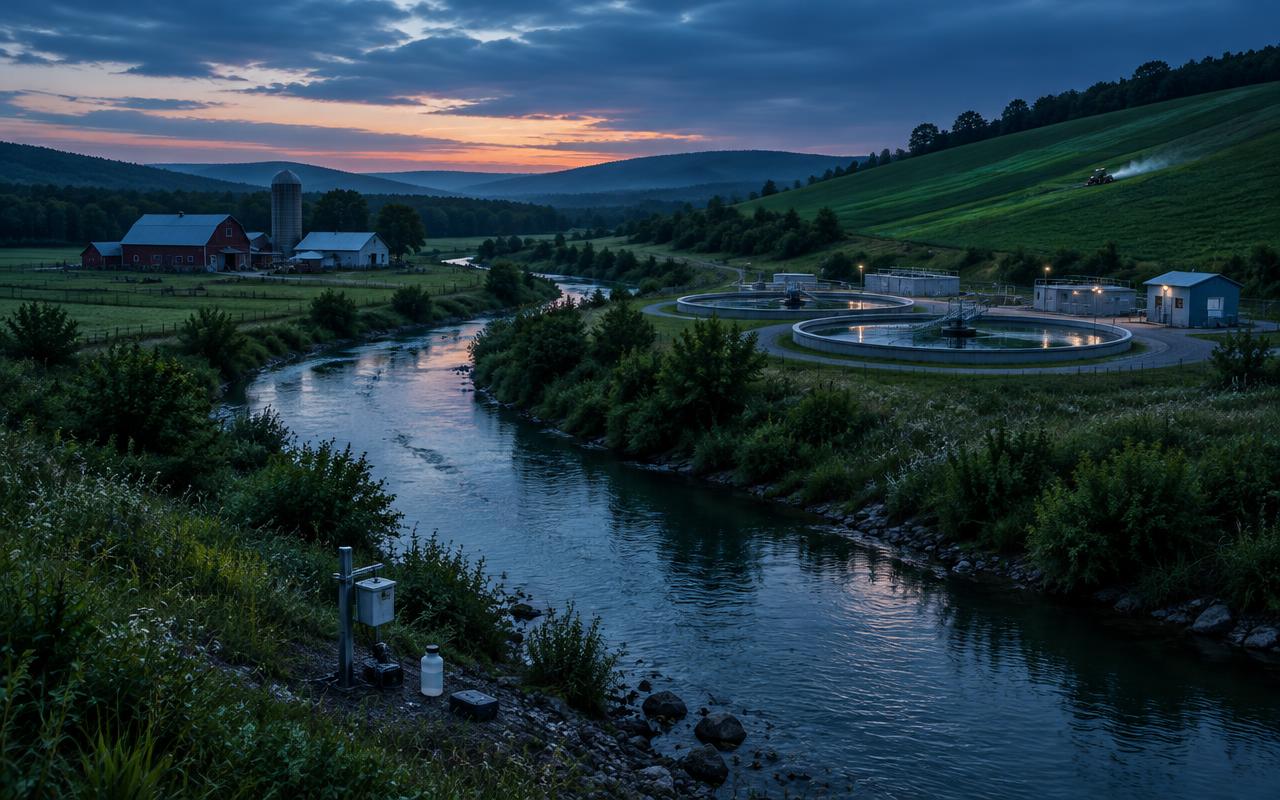
A river with three possible sources, explained to someone who has never processed a discharge permit. The model apportions. A role signs. You prepare the note.
Developed under the new AI Act model · Continuous updates

Edition 2026
200 hours of applied learning
8 academic credits
25 lessons + 6 workshops
Digital campus
Verifiable certificate
550 USD one payment · or 2 × 275 USD (today and after 30 days)
What you'll learn
- Point to the place before the number: source, watercourse, sampling point and written limit.
- Read a sample above the limit and know what it does and does not trigger, with its uncertainty.
- Keep the model's apportionment as a hypothesis, with basis and range, never as the name of a culprit.
- Choose between sensor, satellite, digital twin and field campaign by the information they add and what they cost.
- Spot and stop the gesture that turns an AI output into a forwarded accusation.
- Write a note that withstands a question, with the report's signature left blank.
- Apply the IntellCore AI Act Method™: classify the risk of an AI use case in your field and document it under the AI Act 2026.
Program curriculum
01 — The place
- What AI is and how it reached environmental engineering
- Who discharges, into which watercourse, and what the limit is
- Three paths for the same nitrogen
- Who takes the sample and who signs
- Your role
02 — The number
- How it is sampled and which laboratory it goes to
- Above the limit: what it triggers and what it does not
- Tuesday's sample, without the model
- One sample does not settle the apportionment
03 — The boundary
- The model splits the nitrogen
- Sixty per cent is not proof
- What is missing
- It is recorded as a hypothesis
04 — The tool
- Sensor, drone and satellite
- A copy of the catchment
- What the model itself consumes
- The hypothesis beneath the data
05 — The failure
- The table is pasted and the 60 % accepted
- Neither the flow nor the permit is checked
- The sentence is forwarded as a report
- What to remove from the text before sending it
06 — The file
- Sample, limit, apportionment, gap
- What would be repeated and what is not claimed
- Who signs and who only calculates
- A note that withstands a question
07 — IntellCore AI Act Method™ applied to your field
- The EU AI Act 2026: risk levels, prohibited practices and obligations
- Transparency, human oversight and documentation in your professional field
- Classifying and auditing a real AI use case step by step
- Your compliance file: certified with the IntellCore AI Act Method™
Practical application
- · Final project: Tuesday's note, with the data, the proposal, what was not checked (with the model's apportionment as a hypothesis) and the report's signature left blank, defended against six hard questions.
Practical project: Final project: Tuesday's note, with the data, the proposal, what was not checked (with the model's apportionment as a hypothesis) and the report's signature left blank, defended against six hard questions.
Who is this for?
- · People who will face a sampling report without ever having processed a permit
- · Environment, water and municipal teams without technical vocabulary
- · Analysts who review model outputs
Requirements
- · No prior experience in environmental engineering
- · No coding required

Meet your instructor
AI for Environmental Engineering
Chair, AI for Environmental Engineering
Discharges, river samples, written limits and source-apportionment models — the model apportions, a signing role reports.
Teaches: AI for Environmental Engineering
Edition 2026
What each week includes
Every week of the program follows the same structure.
- 01
Explainer video per lesson
- 02
Guided reading (6 h)
- 03
IntellCore Labs · ~90 min workshop with data
- 04
Verified real case
- 05
IntellCore Podcast
- 06
IntellCore Radar
- 07
Self-assessment
- 08
Practice and exam (70%, 3 attempts)
- 09
Extended practice (5 h)
- 10
IntellCore AI Act Method™ module applied to your field (30 h)
- 11
Applied final project (30 h)
- 12
6 modules × 23 h + IntellCore AI Act Method™ module 30 h + final assessment 2 h + final project 30 h = 200 h
- 13
Downloadable PDF summary

Verifiable certificate
200 hours · 8 academic credits
Unique verifiable code at intellcore.ai/verify
Student reviews
Reviews are published from verified students only, after the first cohort completes the program. We do not publish testimonials we cannot attribute.