AI for HealthNew
First 2027 scholarship call
AI for Physiotherapy
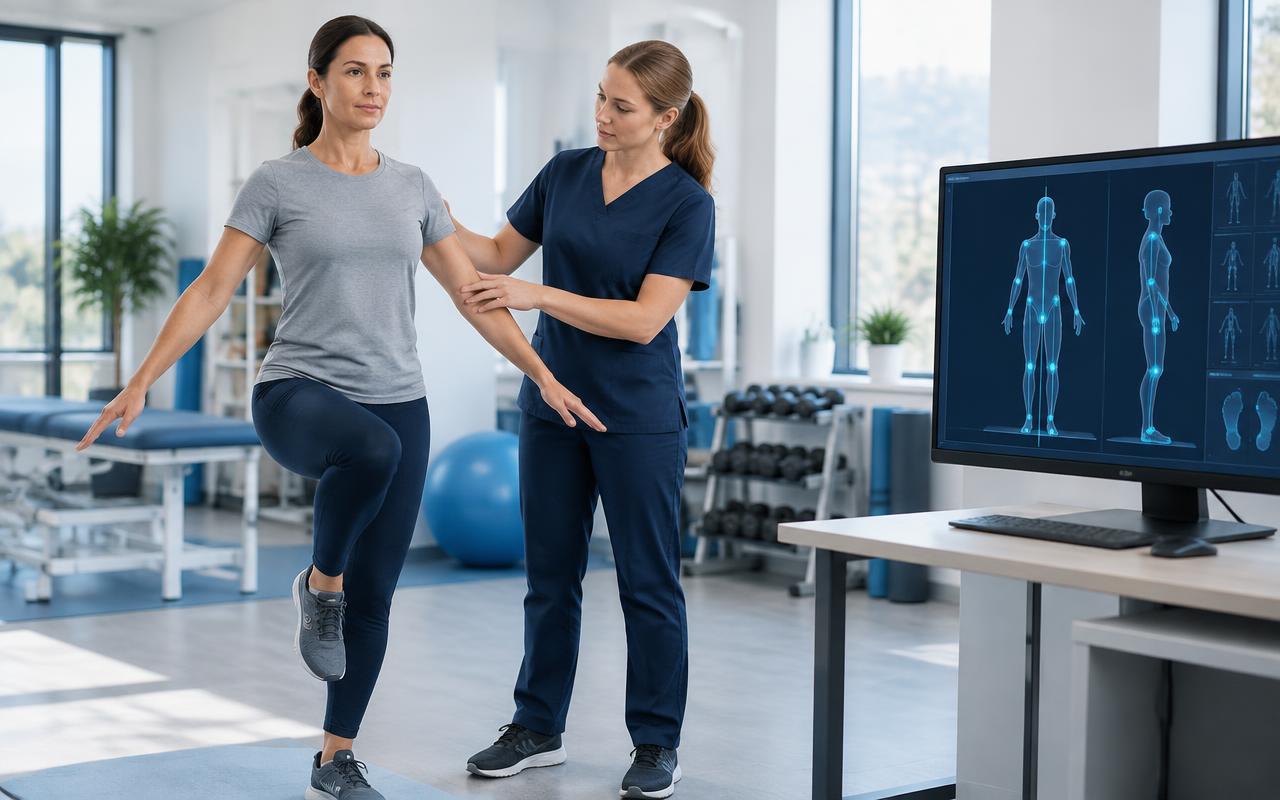
Learn to use AI in physiotherapy with sound judgement: movement analysis, wearables, exercise prescription, telerehabilitation and clinical notes. A fictional physiotherapy centre case. The model suggests. The physiotherapist decides.
Developed under the new AI Act model · Continuous updates

Edition 2026
200 hours of applied learning
8 academic credits
25 lessons + 6 workshops
Digital campus
Verifiable certificate
550 USD one payment · or 2 × 275 USD (today and after 30 days)
What you'll learn
- Explain what AI is and which tools physiotherapy uses today, along with their limits.
- Validate movement measurements from computer vision and sensors against the clinical reference.
- Design safe exercise and telerehabilitation programmes, with red-flag detection and referral.
- Use AI to search for evidence, measure outcomes and reason through cases without delegating the clinical decision.
- Review ambient-scribe notes and apply regulation and professional principles on AI.
- Defend an AI plan for a physiotherapy centre with a pilot, indicators and governance.
- Apply the IntellCore AI Act Method™: classify the risk of an AI use case in your field and document it under the AI Act 2026.
Program curriculum
01 — AI in physiotherapy
- What AI is, who invented it and where it came from
- From lab biomechanics to computer vision: AI arrives in physiotherapy
- The 2026 landscape: documentation, movement, clinical decisions and telerehabilitation
- Language models in physiotherapy: safe uses and verification
- Data, wearables and privacy
- Workshop 1 · Map of AI uses and risks at Mova
02 — Movement analysis
- Computer vision and pose estimation
- Inertial sensors and wearables
- Validity and reliability: comparing against the reference
- Measuring range of motion and gait in the clinic
- Workshop 2 · Validation of the goniometry app against the goniometer
03 — Exercise prescription and telerehabilitation
- AI-assisted exercise programmes
- Telerehabilitation and digital platforms
- Adherence, feedback and motivation
- Safety: red flags, triage and referral
- Workshop 3 · Home programme and red-flag protocol
04 — Clinical reasoning and evidence
- Decision support and prognosis prediction
- Searching and synthesising evidence with AI
- Outcome measures and questionnaires (PROMs)
- Neurological and sports: use cases
- Workshop 4 · Evidence report for a case and measurement plan
05 — Documentation, ethics and regulation
- Ambient scribes and SOAP notes
- Regulation: medical software, the AI Act and Latin America
- Professional principles on AI in physiotherapy
- Liability, consent and equity
- Workshop 5 · Audit of 25 scribe-generated notes
06 — Final project: an AI plan for a physiotherapy centre
- Designing the plan
- Pilot and measurement
- Governance, training and updates
- Report and defence
- Workshop 6 · Mova's AI plan and final report
07 — IntellCore AI Act Method™ applied to your field
- The EU AI Act 2026: risk levels, prohibited practices and obligations
- Transparency, human oversight and documentation in your professional field
- Classifying and auditing a real AI use case step by step
- Your compliance file: certified with the IntellCore AI Act Method™
Practical application
- · Map of AI uses and risks at Mova
- · Validation of the goniometry app against the goniometer
- · Home programme and red-flag protocol
- · Evidence report for a case and measurement plan
- · Audit of 25 scribe-generated notes
- · Mova's AI plan and final report
Practical project: AI plan for Mova Physiotherapy: map of uses, validation of a goniometry app, home programme with red flags, audit of scribe notes and a pilot with stopping criteria.
Who is this for?
- · Physiotherapy
- · Sports physiotherapy
- · Neurorehabilitation
- · Occupational therapy
- · Return-to-play rehabilitation
- · Centre management
Requirements
- · No technical knowledge or programming required.
- · Basic use of documents and spreadsheets.
- · Work exclusively with the fictional case and synthetic data; never enter real patient data.
Edition 2026
What each week includes
Every week of the program follows the same structure.
- 01
Explainer video per lesson
- 02
Guided reading (6 h)
- 03
IntellCore Labs · ~90 min workshop with data
- 04
Verified real case
- 05
IntellCore Podcast
- 06
IntellCore Radar
- 07
Self-assessment
- 08
Practice and exam (70%, 3 attempts)
- 09
Extended practice (5 h)
- 10
IntellCore AI Act Method™ module applied to your field (30 h)
- 11
Applied final project (30 h)
- 12
6 modules × 23 h + IntellCore AI Act Method™ module 30 h + final assessment 2 h + final project 30 h = 200 h
- 13
Downloadable PDF summary

Verifiable certificate
200 hours · 8 academic credits
Unique verifiable code at intellcore.ai/verify
Student reviews
Reviews are published from verified students only, after the first cohort completes the program. We do not publish testimonials we cannot attribute.